
Showing posts with label Agency and Control. Show all posts

Thursday, 1 November 2018

Manipulative And Distracting Ads Are Ruining Kids Apps, Researchers Say

Prompted by an alarming new study, advocacy groups want the feds to investigate how apps target preschoolers.

Last updated on October 30, 2018, at 8:00 a.m. ET
Posted on October 30, 2018, at 12:02 a.m. ET


Bubadu / FTC / Via commercialfreechildhood.org, Outfit7 / Via outfit7.com
Popular apps for young kids, especially those available in Google’s app store, are teeming with advertisements that distract them from play, manipulate them to make purchases, and extract their personal data.
That’s the conclusion of a new study that’s prompted a slew of child advocacy groups to ask the US federal government to investigate these products. The groups argue that many apps violate the Federal Trade Commission Act by disguising ads, programming characters to lure kids into purchases, or misleading parents into thinking the games are educational.
“What we’re hoping is that the FTC will fine the app developers and fine them enough that it sends a clear message to the preschool app industry,” Josh Golin, executive director of the Campaign for a Commercial-Free Childhood, told BuzzFeed News. His group and 21 others signed a letter sent to the FTC today outlining their concerns, based largely on the new study’s findings.
On TV, ads aimed at kids must follow certain rules. Product placement isn’t allowed, for example, and neither is “host selling,” when a character encourages kids to buy something. But those rules, set by the Federal Communications Commission, don’t apply to the internet. “The FCC wouldn’t touch this,” Golin said. “We have this regulatory vacuum.”
The new study looked at 135 kids apps, a mix of paid and free, iOS and Android, including 96 of the most frequently downloaded in the “Ages 5 and Under” category of the Google Play Store. About one-third were labelled “educational.” Most of the free apps had been downloaded more than 5 million times each, and the paid ones more than 50,000 times.
Almost all — 88% of paid apps and 100% of free ones — contained at least one type of advertising, the study found, such as pop-up ads, banner ads, in-app purchases, and commercial characters.
Banner ads sometimes showed content that’s inappropriate for kids, the researchers said, such as a Health Living Today ad for “10 Bipolar Facts to Learn: Search Treatments.” Other ads were for apps like Pocket Politics, a game that shows a cartoon of President Trump wanting to press a “nukes” button, and FastLand, a car shooting game. Both of these app ads played a demonstration video before they could be closed.


A screenshot from Bubadu’s Doctor Kids.


Bubadu / FTC / Via commercialfreechildhood.org
A screenshot from Bubadu’s Doctor Kids.
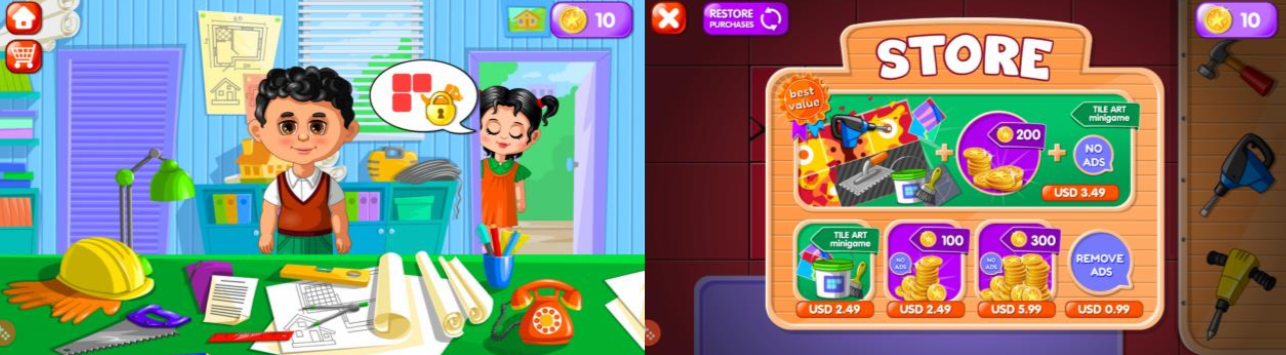
For Golin, one of the most disturbing examples was Doctor Kids, which shows a character crying if you don’t click on an in-app purchase. “Children form real attachments to these characters,” he said. “For a kid, that’s a pretty powerful thing to express, when a character is crying.” (Doctor Kids’ maker, Bubadu, did not respond to a request for comment.)
Nine of the kids' apps contained what the researchers call “camouflaged” ads, which are made to look like part of the game but bring up a video ad when clicked. On the My Talking Tom app, for example — which has had more than 500 million installs, according to Google Play — kids will see a present drop down from the ceiling. If they tap on it, they’ll be prompted to “watch videos and win.” (The maker of My Talking Tom, Outfit7, did not respond to a request for comment.)
In Builder Game, which has more than 10 million installs on Google Play, thought bubbles pop up over characters telling the child what to do. Sometimes, the study found, the bubbles led to games that could only be played after watching an ad. (Builder Game’s creator, also Bubadu, did not respond to a request for comment.)
The leader of the new study, pediatrician Jenny Radesky of the University of Michigan, remembers one morning last winter when she observed her then 8-year-old son playing an app called Masha and the Bear Vet Clinic, in which he tried to help remove thorns from a sick wolf. After watching an ad video, the game gave him a tweezer that made it easier to get the thorns out and accumulate candy rewards.
“I asked him, ‘Why are you willing to watch an ad video just to do that?’ He said, ‘I get candy,’” Radesky told BuzzFeed News. (The owner of Masha and the Bear, Animaccord, did not respond to a request for comment.)
Her son is like most kids his age or younger, she said, who don’t have the critical thinking skills to understand the “persuasive intent” of an advertisement — that the apps want you to watch the ads because they financially benefit. “That sort of stuff was really hard for him to understand.”
Past studies have shown that even brief exposures to ads embedded in cartoons and other media can influence children's brand preferences, noted Tom Robinson, professor of pediatrics at Stanford University. It's "disheartening," he said, "that so many app makers are willing to use such insidious methods that so obviously take advantage of children’s vulnerabilities."
Most of the public furore over screen time, both in academic studies and the popular press, has focused on the amount of time that kids use apps, with kids under 5 averaging about one hour per day with mobile devices. But researchers are beginning to recognize that what kids are seeing and doing with technology is just as, if not more important than how long they’re doing it. (Radesky, for example, is not anti-app: For patients who struggle with temper tantrums, she recommends watching Daniel Tiger’s Neighborhood apps, which she says can “teach both parent and child what to do in a moment of stress.”)
In 2016, Radesky helped write the latest American Academy of Pediatrics guidelines for kids and screens. Although the guidelines were less restrictive than the previous version, when it came to the subject of advertisements they drew a hard line, saying that advertisements in kids apps should be eliminated. “It’s not ethical because they don’t understand it. They’re just going to click on it,” Radesky said.
Another big concern of kids apps is data privacy. Although the Children’s Online Privacy Protection Act (COPPA) limits how much personal information can be collected and tracked from kids under 13, thousands of apps distributed by Google may violate the rule, according to a report published earlier this year. Six apps analyzed in the new study requested users’ location information, a potential violation of COPPA.
“It’s a race to the bottom right now with a lot of these preschool apps,” Golin said. “Their whole goal is to get higher in the Google Play Store ranking.”
Platforms like Google and Apple have a gatekeeping role to play, he and Radesky agreed. Apple, for instance, doesn’t allow apps to be listed in the “Kids” category of its iOS App Store if they have in-app purchases (unless they are behind a parental gate), or if they serve ads based on the user’s activity (although they can still serve ads).
Perhaps it’s not surprising that Apple, which built a business around fancy devices and curated services, would have app rules that could hurt its advertising revenue. Google, on the other hand, is in the ad business.
In an emailed statement, a Google spokesperson said that Google Play apps primarily directed at children must participate in its “Designed for Families” program. They must adhere to COPPA rules and certain ad and content restrictions. “Additionally, Google Play discloses whether an app has advertising or in-app purchases, so parents can make informed decisions.” (One of its kid-specific rules, for example, forbids showing ads that could be mistaken for app content — which seems to have been violated by some of the apps flagged in the new study.)
Radesky hopes platforms like Google and Apple will do more. “If they could just put the good stuff up top, that would be awesome.”

Saturday, 16 September 2017

Media laws: Who will buy what and will it make any difference anyway?


Via abc.net.au/news/2017-09-15/australian-media/8949574 By business reporter Stephen Letts Updated 16 September 2017


As the new media laws finally clambered over their last obstacle, you could almost hear the high-fives slapping in the boardrooms of the big — although somewhat diminished — media companies.

Key points:
  • Fairfax and Nine appears to be the most plausible and powerful merger opportunity
  • News Corp's main hurdle to any acquisition is likely to be the ACCC
  • Even after merging most businesses would still struggle to grow sales in the face of massive competition from overseas digital giants
The denouement of the drawn-out and fraught process, televised on the Senate channel, had more the torn and frayed look of the Survivor franchise than the smoochy fairytale feel of The Bachelor, which aired around the same time.

So now the rule book has been rewritten, how is the game going to change? And is the promise of mergers and takeovers of struggling media businesses going to create new champions able to protect and expand their turf?

Certainly, the prospect of mergers is real — if for no other reason than: why did the media owners champion the changes in media ownership rules? Will they be successful? That is an entirely different question.

What are the new rules?

It was not so much a rewriting of the Broadcasting Legislation Amendment Bill as just hitting delete on a couple of key provisions that changed things. Out went the "75 per cent audience reach" rule prohibiting a TV network broadcasting to more than 75 per cent of the population. It opens up possibilities for the likes of Seven, Nine, Ten and the regional players Prime, Southern Cross and WIN.
The removal of "two-from-three" rule — owning any two of TV, print and radio was OK, owning all three was not — is the one that puts everybody into play. There are also bits like replacing TV and radio licence fees with a "spectrum fee", although they are unlikely to make much difference to the flow of deals in the wings. However, that doesn't mean it is total open slather — some checks remain.

The "five/four rule" enshrined by the Howard government in 2007 to prevent the number of media owners falling below five in capital cities and four in regional areas, is still on the books, while the Australian Competition and Consumer Commission — with its own rule book — is still on the prowl looking to bust market domination. To lesser extent, the Foreign Investment Review Board and shareholders themselves are in the mix, but they have never really been known to stop media takeovers.

A couple of times, shareholders have tried to stand in the way of a merger — to wit, a body of West Australian Newspaper investors against Kerry Stokes in 2011 and Ten investors at the moment — but they have generally been run over in the process.


Here are the most likely deals

The big investment bank, Morgan Stanley, has tallied up the permutations and combinations flowing from the law changes and has come up the most likely deals. There are a fair few options, but for the sake of brevity, this is the short list of the bigger deals being discussed:
  • Nine Entertainment and Southern Cross;
  • Fairfax Media and Nine;
  • Seven West Media and Prime Media;
  • News Corporation and just about anyone.
Nine and Southern Cross have previously said they've had discussions, but Nine's sale of its 10 per cent stake in the regional broadcaster was not seen as a positive step to a future takeover. Would it create a bigger, stronger company? Morgan Stanley's Andrew McLeod thinks not. "Bigger combined audience reach, yes, but higher growth and higher return on capital are questionable," Mr McLeod said.

So Fairfax and Nine? Far more plausible and powerful, according to Mr McLeod. "This could be a rare opportunity to combine media assets and actually lift revenue growth rates via the two online businesses," he said. "Nine's video content could strengthen Fairfax's online video capability and lift traffic and audiences for the Fairfax sites."

Importantly, Mr McLeod notes both companies have little or no debt, which is a big advantage in delivering a highly positive earning per share outcome to both sets of investors.

Seven has always been regarded as a natural predator for its regional partner Prime and now the reach rule has been removed, it is off the leash. Given Prime is a reseller of Seven content, no-one else is likely to bid for it. Does it make sense for Seven? Sort of, but Prime is a lean operation and the cost savings in merging the two may not be large enough to make it worthwhile, and the potential for ongoing earnings growth is minimal.

News Corp is the $10b gorilla

Talking about off the leash, News Corp has never been shy about buying businesses — good, bad or indifferent, profitable or unprofitable — it just buys them and considers the consequences and write-downs later.

Last month, it wrote down the value of sundry newspapers, its stake in Foxtel and the REA real estate portal by $1.3 billion. Although that is dwarfed by the impairments News Corp has racked up by buying the likes of Dow Jones and Gemstar over the years. With its US rival CBS likely to snaffle Ten, News Corp could well turn its attention to Nine or Seven.

News already owns plenty of assets here and so any deal could be quite cost-effective or nerve-racking, depending on whether you are a shareholder or work in a newsroom facing further "rationalisation". The merger of online businesses and picking up Nine or Seven video content would be handy for News Corp's digital platforms.

Of course, any move from News while OK under the new media laws would still need to leap any hurdle put in its way by the ACCC. News could always satisfy itself with a tasty morsel like the $700 million Here, There & Everywhere radio network owner of brands such as KIIS and Gold, as well as the Adshel outdoor advertising business.


Player
Earnings (2018 estimates)
Market capitalisation
News Corporation
$1.135b
$10b
Seven West Media
$208m
$1.1b
Nine Entertainment
$206m
$1.2b
Fairfax Media
$268m
$2.2b
Southern Cross
$171m
$1b
Here, There & Everywhere
$120m
$700m
Prime Media
$53m
$100m
Earnings based on Morgan Stanley estimates of earnings before interest, tax, depreciation and amortisation (EBITDA).

What does history teach us?

The last significant media law changes in 2006 — largely centred on abolishing foreign ownership rules — certainly arced up deal making, both large and small. It also sparked activity not held back by foreign ownership issues.

The then-Packer vehicle PBL sold half its media assets to the foreign private equity business CVC, proving you can have more than Alan Bond in your life. Kerry Stokes also hooked up with private equity, this time Kohlberg, Kravis, Roberts selling it a 50 per cent stake in his media assets including Seven and the magazine business for $3.2 billion. They are worth about a third of that today. That deal allowed a cashed-up Mr Stokes to get a large foothold in, and ultimately control of, his hometown West Australian Newspapers. Fairfax headed bush and bought Rural Press.

Morgan Stanley's Andrew McLeod says the experience of 2006 shows transactions could occur very quickly in 2017. "Some of the remaining ownership rules, such as the 'five/four minimum voices' rule, present a first-mover advantage for consolidation occurring in some assets and some markets," he said.

So can the mergers turn back the tide?

The bigger question is whether any of this will create more robust businesses able to compete and grow against the likes of Facebook and Google in the ad market.

Unlike King Canute of yore, who stood in front of a tide to prove his fallibility knowing such things were beyond mere mortals, the Government is backing its plan to help turn back the digital tsunami crashing in from offshore and sweeping away local profits.

Good luck with that, says Mr McLeod. "We think the key debate is whether on the other side of any merger and acquisition, higher growth/better quality media companies emerge — or if after one year's costs savings are banked, the downward trajectory in earnings and shareholder value resumes," he said. "We can envisage a few genuine re-invention opportunities, but in most cases it's more likely the latter."

Crushed: Digital giants vs Australian media

Last year Australian TV networks lost around $1 billion between them, newspapers have lost even more over recent years, while profitability in radio is flat-lining at best. The test will be to achieve real top-line growth in sales, not just confected and unsustainable profit growth from cost-cutting.

The problem there is the advertising revenue pool is a bit of a zero sum game — with some GDP-style growth added in. In such a relatively stagnant pool, gaining sales means someone is losing. And on an exponential scale, the digital giants are winning and everyone else is losing.  The one thing the likes of Facebook and Google won't do is bail out Australian shareholders with an ill-considered purchase of an old economy business. They are not that dumb.


Thursday, 6 July 2017

Game tests your ability to spot fake news—and it’s not as easy as you’d think


Factitious was designed as way to help people recognise what news is fake.
Spotting fake news can be hard with so much of it polluting your timelines and news feeds. But one game wants to help you brush up your skills so you don’t get fooled in the future.
The game, Factitious, was designed by former American University Fellow Maggie Farley and Bob Hone, a professor at the University. The game was created in the college’s American University Game Lab.

Essentially, the game uses a Tinder-like interface that has people swipe left or right to see if they can spot fake news. Swipe left if you think the article that pops up in front of you is fake and swipe right if you believe the sample article is real.

In Factitious, the game defines fake news as “stories fabricated for fun, influence, or profit, as well as satire, opinion, and spin”—not stories you don’t agree with (which is how President Donald Trump uses the phrase).

“Fake news is impossible to stop, so we wanted to playfully teach people how to recognise it,” Farley said in a blog post about the game. “But the game is fun to play in itself.”

With fake news proliferating wildly since the 2016 election, being able to spot it is essential for anyone who wishes to read factual news. Factitious helps you spot what stories are fake and even gives you a bit of a hint by looking at the source of the article (which is helpful to know moving forward).

 on The Daily Dot

Monday, 3 July 2017

In a Fake Fact Era, Schools Teach the ABCs of News Literacy


Fourteen-year-old Isabel Catalan stares intently at her laptop as she walks me through a recent assignment one sunny morning a few weeks before summer vacation. The studious eighth grader and I are sitting in a tiny, colourful classroom at Norwood-Fontbonne Academy, a small private elementary school in the tree-lined Philadelphia suburbs, which also happens to be my Alma mater.

In most ways, Norwood feels a lot like I left it nearly 20 years ago. Catalan wears the same plaid kilt and golf shirt combo that I did, and lugs her books from class to class in the same blue canvas tote we used to call our "daily bags." In the hallway I pass my old social studies teacher, who’s been working here for almost half a century. On a bookshelf in Catalan’s classroom, I spot a roughed up copy of The Face on the Milk Carton that I’m almost certain I checked out from the library sometime around 1999.But in other ways—important ways—the school is radically different. The clunky desktops and overhead projectors have given way to flatscreens and laptops in every classroom. And while back then Microsoft Encarta was our main research tool, today Norwood students have a world of information—and misinformation—ever at their fingertips.

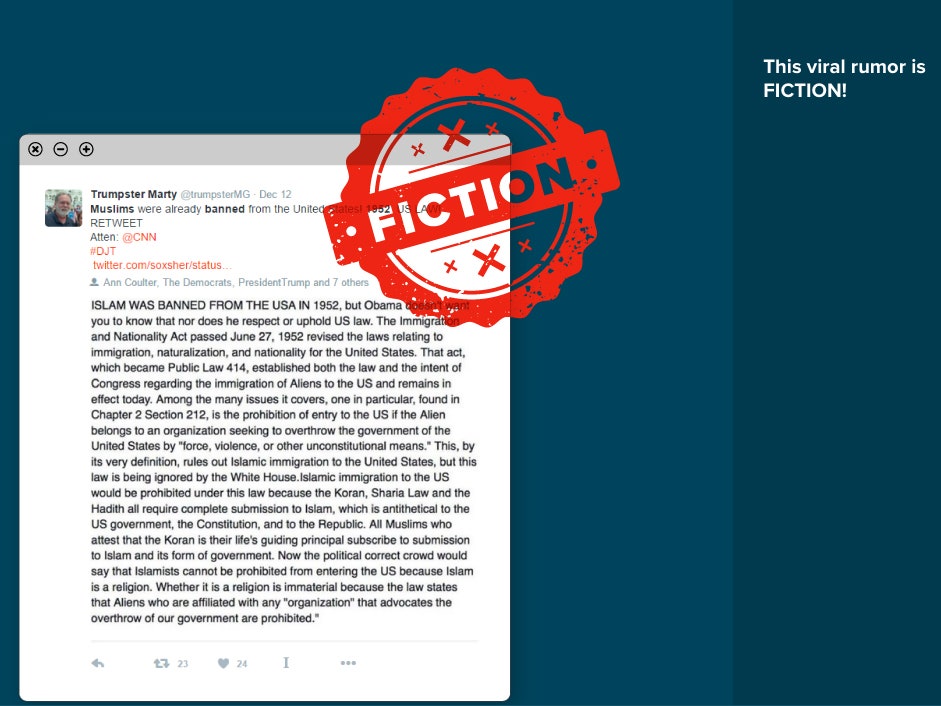
Which brings us to Catalan’s assignment. On the screen in front of her is a viral tweet written by one TrumpsterMarty: "Muslims were already banned from the United States! 1952 US LAW! RETWEET." It comes with a screenshot describing the Immigration and Nationality Act of 1952, which barred immigration by anyone who seeks to overthrow the government "by force, violence, or other unlawful means."

Image by Issie Lapowsky
"This, by its very definition, rules out Islamic immigration to the United States," the screengrab reads.


Catalan, who wears her pin-straight brown hair brushed all the way down her back, pauses for a beat. “This one, I had to think about,” she says. Then she talks it through. "I looked at who posted it: TrumpsterMarty," she says. "The person who posted this wanted you to retweet it. It just doesn’t sound accurate."

She decides the post is fiction, and Checkology, the online platform she’s showing me, tells her she’s right. Checkology is the latest creation of the News Literacy Project, a non-profit founded by former Los Angeles Times reporter Alan Miller. Since 2009, the tiny eight-person non-profit has been working one on one with schools to craft a curriculum that teaches students how to be more savvy news consumers. Last year, in an effort to scale its impact, the team bundled those courses into an online portal called Checkology, and almost instantly, demand for the platform spiked.

“Fake news is nothing new, and its impact on the national conversation is nothing new, but public awareness is very high right now,” says Peter Adams, who leads educational initiatives for News Literacy Project. Now, Checkology is being used by some 6,300 public and private school teachers serving 947,000 students in all 50 states and 52 countries.
Norwood began using the program in March following one of the most frenetic elections in American history. Inspired by the avalanche of "alternative facts" and fake news they were seeing in their own social media feeds, teachers Lindsey Sachs and Shannon Craige decided to launch a four month-long course in teaching students to sift fact from fiction online.
Checkology

"News has shifted so much. Everyone can be a reporter now," says Sachs, the school’s technology teacher. "It’s about them realising you can’t take everything at face value."
The platform offers lessons on the First Amendment, the difference between branded content and news, and how to distinguish between viral rumours—political and otherwise—and reported facts. Teachers help the kids understand sourcing, bias, transparency, and journalistic ethics. The platform also includes interviews with working journalists such as Matea Gold at The Washington Post, who help put a face to the boogeyman that has become known as "the media."


"This is no longer something that if we have time to expose children to, that would be great," says Michelle Ciulla Lipkin, executive director of the National Association for Media Literacy Education. "This is a crisis situation. We do not teach our students enough about what they need to understand about the world they live in." Checkology, she says, is one important tool helping to change that.

Infograzers

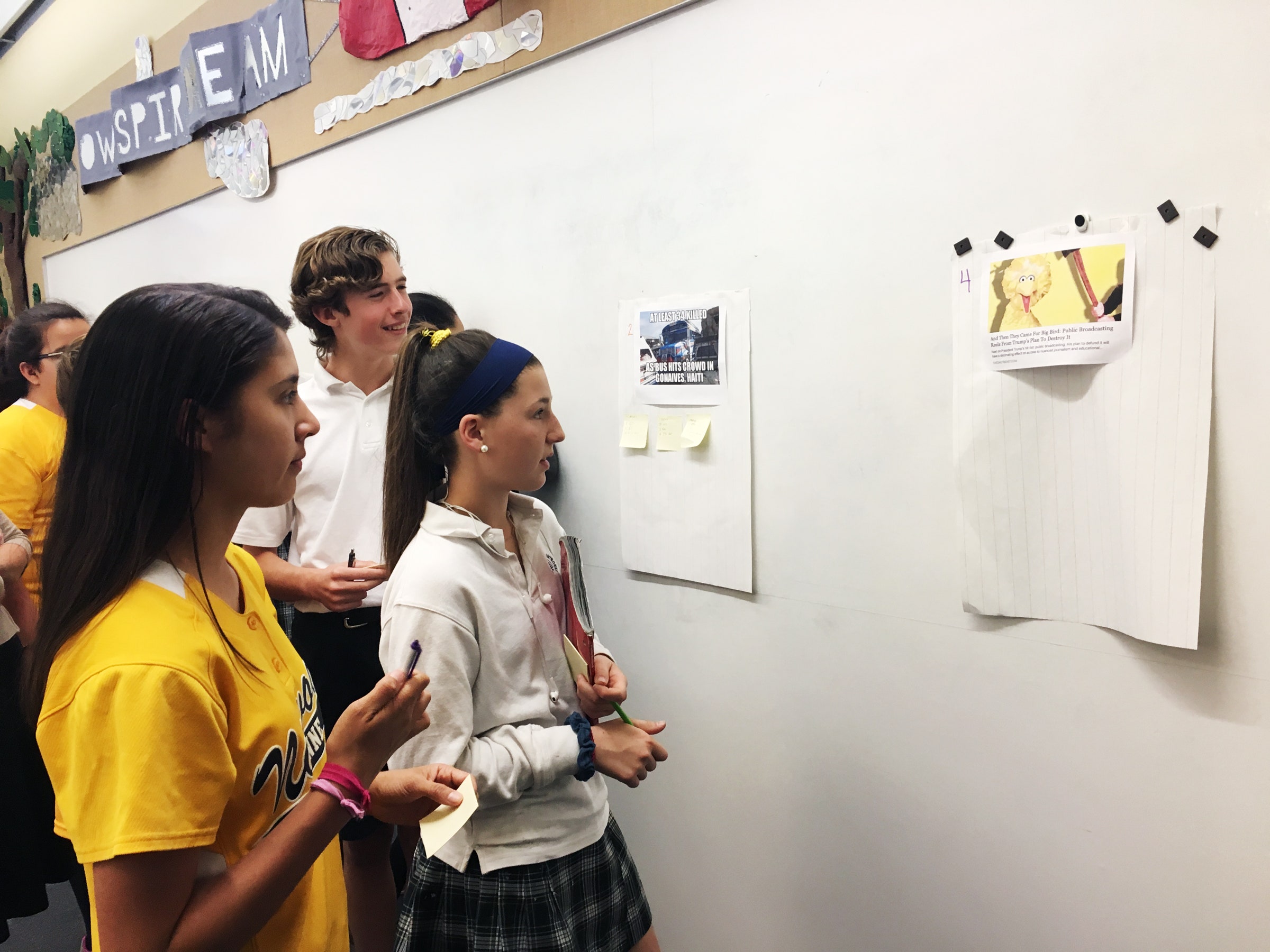
On the day I returned to my Alma mater, the students were categorising online posts as news, entertainment, propaganda, publicity, advertising, raw information, or opinion. As Craige stood by, 13-year-old Catherine Aaron, an 8th grader already dressed in her softball uniform for that day's game, puzzled over a headline from the left-leaning outlet Daily Beast. It read, "And Then They Came for Big Bird: Public Broadcasting Reels From Trump’s Plan to Destroy It." The sub-headline continued, "Next on President Trump’s hit list: public broadcasting. His plan to de-fund it will have a decimating effect on access to nuanced journalism and educational TV." Aaron had a hunch this was the author's opinion. "What makes you think that?" Craige prompted the 8th grader.

"The language of it is more of an opinion," Aaron says. "Decimating. Destroying." Sophie Giovonnone, 14, isn't so sure. She thinks it might be working as publicity for Democrats, "because it could cause some conflict" for Trump.

I ask Giovonnone whether she knows what the Daily Beast is. She doesn't. In fact, most of the students say that outside of class, they rarely encounter much news online at all. Only one student in the whole class uses Twitter. No one even has a Facebook account. Their social media lives consist mainly of Instagram and Snapchat, one of the few platforms that still meticulously curates what news is and isn't allowed in its Discover feature. (WIRED recently joined Discover.)

For a moment, I think, maybe the fact that these students aren't using Facebook or Twitter is a promising sign. Maybe the very nature of the platforms this generation is growing up with will shield it from the internet's onslaught of misinformation. But Adams stops me short. Kids today, he says, are "infograzers." Without realising it, the memes they share and and viral videos they watch each day are telling them stories about the world they live in—not all of them true.

"What counts as news has broadened for this generation," he says. "Unless they learn to flag content and figure out why something might not be sound evidence, it sticks with them." And even if they're not skimming social media, it's become second nature to them to whip out their smartphones and Google the answers to any questions they don't know. Tools like Checkology encourage them to dig deeper than the first headline that turns up.

As they get older, the spectrum of online sources they use will broaden even further, and that's when these skills will matter most, says Ciulla Lipkin. "When we were growing up some of the work we’re doing in school might not have seemed relevant at the time, but it’s teaching students skills they need for the future," she says. "It gets students to practice asking questions." Or, as Sachs puts it, "We're arming them before they hit the battle."

The question is—as it is for all school subjects—will that practice stick as students grow up and technology evolves? The company is currently crunching the numbers on its first quantitative survey that measures how students' understanding of the topic changes from the beginning of the course to the end.

Catalan, Aaron, Giovannone, and the rest of the 8th grade class walked away from Norwood on Monday for the last time. This fall, they'll head off for high school. If by some chance they return to this place 20 years down the road, as I did, they will no doubt find that the world of communication has changed even more drastically since they sat in these very seats. Now, as the country continues to fight over the fundamental definition of truth, it falls to educators across the country to prepare their students for whatever mayhem those changes may bring."

Thursday, 8 June 2017

Useful: a cheatsheet for critical thinking

When you encounter new information, here's a list of questions to ask yourself and others. It was produced by the Global Digital Citizen Foundation, "a non-profit organisation dedicated to cultivating responsible, ethical, global citizens for a digital world."


[via]

Friday, 14 April 2017

Facebook Wants To Teach You How To Spot Fake News On Facebook

Posted on April 7, 2017, at 2:00 a.m.
Written by Craig Silverman  BuzzFeed News Media Editor

What the new educational tool will look like in News Feed.
In its latest move to help blunt the flow of misinformation on its platform, Facebook today rolled out a new initiative to educate users on how to spot "false news."

Starting [April 8th, 2017], people in 14 countries will begin seeing a link to a "Tips for spotting false news" guide at the top of their News Feed. Clicking it brings users to a section offering 10 tips as well access to related resources in the Facebook Help Center. Facebook is also collaborating with news and media literacy organisations in several countries to produce additional resources.


"Improving news literacy is a global priority, and we need to do our part to help people understand how to make decisions about which sources to trust," Adam Mosseri, Facebook's VP of News Feed, wrote in a blog post about the initiative. "False news runs counter to our mission to connect people with the stories they find meaningful. We will continue working on this, and we know we have more work to do."

Facebook's 10 tips for spotting false news.
Facebook has now announced several initiatives to try and stop the spread of misinformation and to support trustworthy information. It's working with third-party fact-checking organizations to flag false content in the News Feed; the company recently announced the Facebook Journalism Project to work with news organizations on products and business models; and it's one of the funders of the new News Integrity Initiative, a $14 million project "focused on helping people make informed judgments about the news they read and share online."
These moves come in response to the outcry about the platform's role in spreading fake news stories during the recent US election, and to public pressure it faced after CEO Mark Zuckerberg was initially dismissive of the issue. Now he, COO Sheryl Sandberg, and other top executives talk frequently about the responsibility Facebook has to help provide accurate information to its more than 1.8 billion users.
"We know that seeing accurate news on Facebook is really important to people on all sides," Sandberg recently said on PBS NewsHour. "No matter who you are, seeing the accurate story and seeing a diversity of opinions is really important. We know we have a responsibility, along with newsrooms and classrooms and academic and other companies, to make sure people see accurate news."

Saturday, 8 April 2017

Cool animated overview of how media manufactures consent

Manufacturing Consent feels like a must-read all over again lately, and this excellent primer by animator Pierangelo Pirak lays out the five filters of the mass media machine.


Per Manufacturing Consent, this sounds as if it could have been written about those covering a certain sitting President:
A propaganda model has a certain initial plausibility on guided free-market assumptions that are not particularly controversial. In essence, the private media are major corporations selling a product (readers and audiences) to other businesses (advertisers). The national media typically target and serve elite opinion, groups that, on the one hand, provide an optimal “profile” for advertising purposes, and, on the other, play a role in decision-making in the private and public spheres. The national media would be failing to meet their elite audience’s needs if they did not present a tolerably realistic portrayal of the world. But their “societal purpose” also requires that the media’s interpretation of the world reflect the interests and concerns of the sellers, the buyers, and the governmental and private institutions dominated by these groups.
• NOAM CHOMSKY - The 5 Filters of the Mass Media Machine (YouTube / Al Jazeera English)

via Boing Boing

Wednesday, 23 November 2016

Most students can’t tell the difference between sponsored content and real news

Study underscores the need for more media literacy in schools

by


Most students can’t tell the difference between real news articles and sponsored content, according to a study from Stanford University, raising concerns over how young people consume online media. As The Wall Street Journal reports, the study is the largest to date on how young people evaluate online media, involving 7,804 students from middle school to college. It will be published on Tuesday.

According to the study, 82 percent of students could not distinguish between a sponsored post and an actual news article on the same website. Nearly 70 percent of middle schoolers thought they had no reason to distrust a sponsored finance article written by the CEO of a bank, and many students evaluate the trustworthiness of tweets based on their level of detail and the size of attached photos, according to the Journal.

The US presidential election has sparked a debate over how Facebook and other web companies treat fake news articles, which some have blamed for spreading misinformation ahead of the vote. Facebook CEO Mark Zuckerberg has said the company is working on systems to limit the spread of false information, and Google will ban fake news sites from its lucrative ad network.

But the Stanford study suggests that students still struggle to evaluate the credibility of online sources, making it difficult to sift through more subtle forms of misinformation such as advertising and sponsored posts. Schools have begun offering more media literacy courses, the Journal reports, but they also have fewer librarians to help teach basic research skills. Stanford professor and lead author Sam Wineburg tells the Journal that students should learn to cross-check the legitimacy of websites using other sources and to not always equate a site’s high Google search rankings with accuracy.