Showing posts with label Facebook. Show all posts

Monday, 3 July 2017

In a Fake Fact Era, Schools Teach the ABCs of News Literacy


Fourteen-year-old Isabel Catalan stares intently at her laptop as she walks me through a recent assignment one sunny morning a few weeks before summer vacation. The studious eighth grader and I are sitting in a tiny, colourful classroom at Norwood-Fontbonne Academy, a small private elementary school in the tree-lined Philadelphia suburbs, which also happens to be my Alma mater.

In most ways, Norwood feels a lot like I left it nearly 20 years ago. Catalan wears the same plaid kilt and golf shirt combo that I did, and lugs her books from class to class in the same blue canvas tote we used to call our "daily bags." In the hallway I pass my old social studies teacher, who’s been working here for almost half a century. On a bookshelf in Catalan’s classroom, I spot a roughed up copy of The Face on the Milk Carton that I’m almost certain I checked out from the library sometime around 1999.But in other ways—important ways—the school is radically different. The clunky desktops and overhead projectors have given way to flatscreens and laptops in every classroom. And while back then Microsoft Encarta was our main research tool, today Norwood students have a world of information—and misinformation—ever at their fingertips.

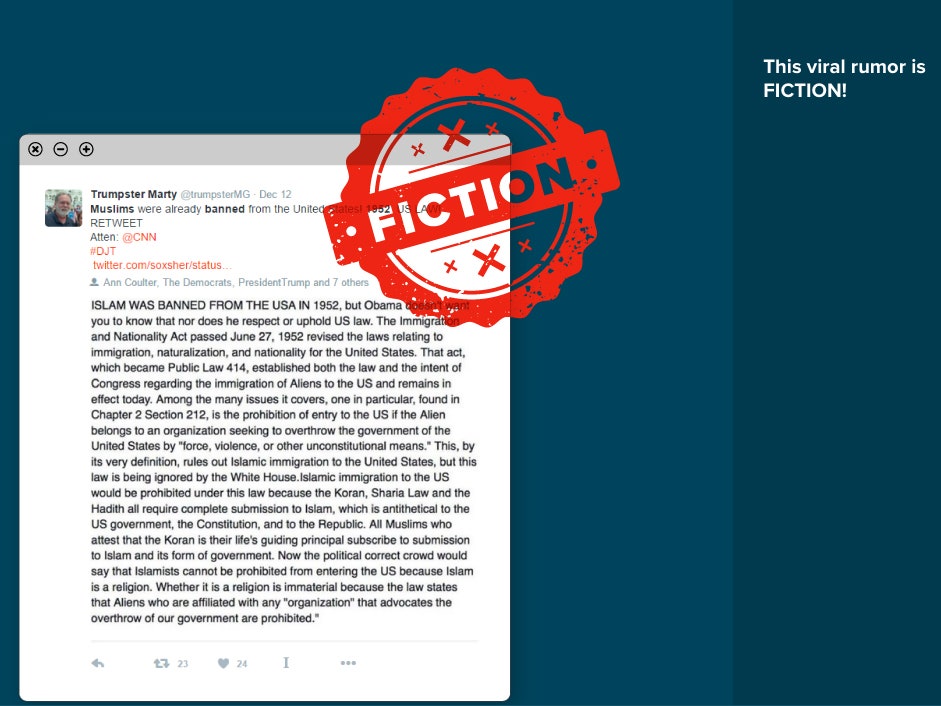
Which brings us to Catalan’s assignment. On the screen in front of her is a viral tweet written by one TrumpsterMarty: "Muslims were already banned from the United States! 1952 US LAW! RETWEET." It comes with a screenshot describing the Immigration and Nationality Act of 1952, which barred immigration by anyone who seeks to overthrow the government "by force, violence, or other unlawful means."
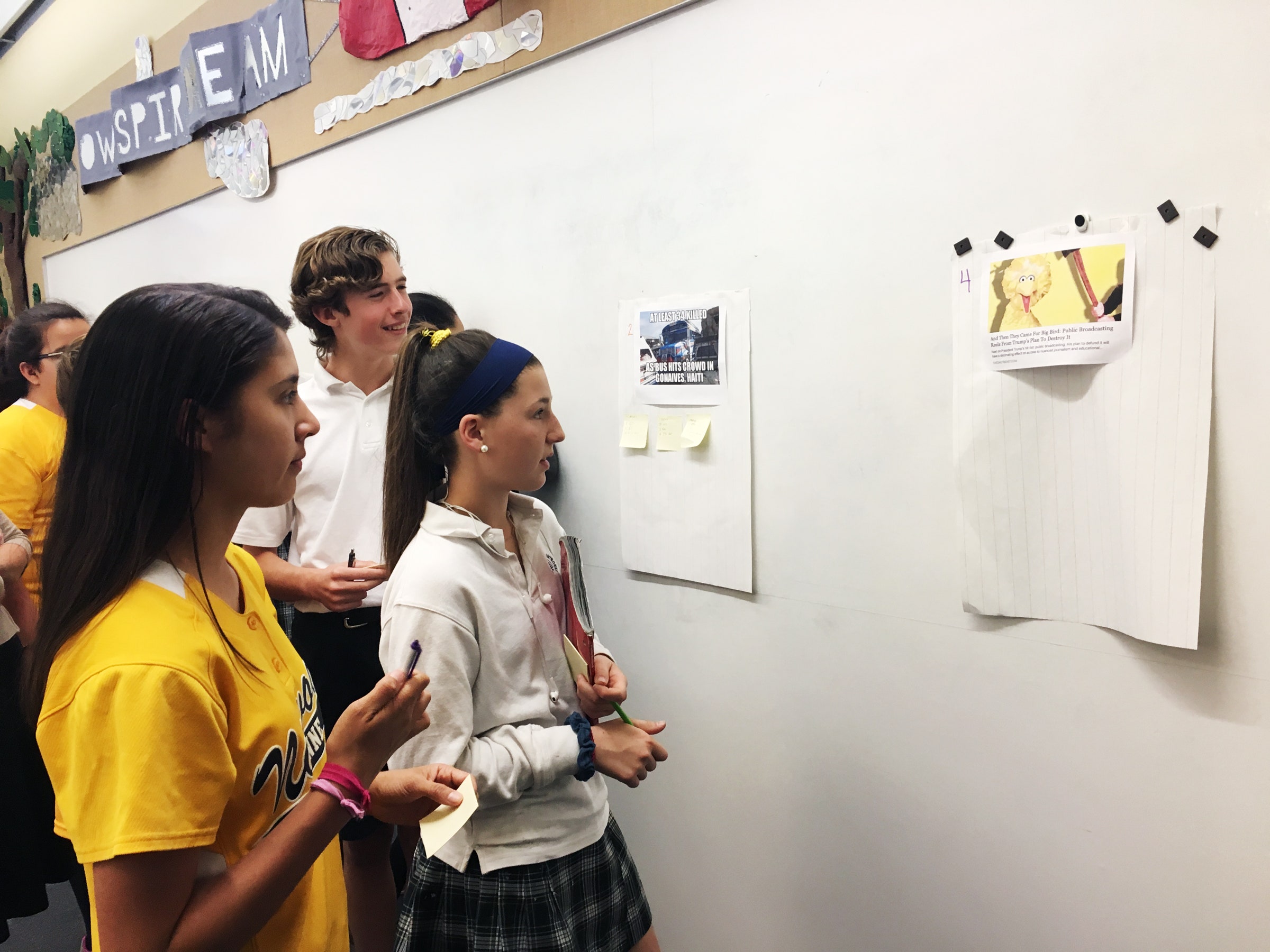
Image by Issie Lapowsky
"This, by its very definition, rules out Islamic immigration to the United States," the screengrab reads.


Catalan, who wears her pin-straight brown hair brushed all the way down her back, pauses for a beat. “This one, I had to think about,” she says. Then she talks it through. "I looked at who posted it: TrumpsterMarty," she says. "The person who posted this wanted you to retweet it. It just doesn’t sound accurate."

She decides the post is fiction, and Checkology, the online platform she’s showing me, tells her she’s right. Checkology is the latest creation of the News Literacy Project, a non-profit founded by former Los Angeles Times reporter Alan Miller. Since 2009, the tiny eight-person non-profit has been working one on one with schools to craft a curriculum that teaches students how to be more savvy news consumers. Last year, in an effort to scale its impact, the team bundled those courses into an online portal called Checkology, and almost instantly, demand for the platform spiked.

“Fake news is nothing new, and its impact on the national conversation is nothing new, but public awareness is very high right now,” says Peter Adams, who leads educational initiatives for News Literacy Project. Now, Checkology is being used by some 6,300 public and private school teachers serving 947,000 students in all 50 states and 52 countries.
Norwood began using the program in March following one of the most frenetic elections in American history. Inspired by the avalanche of "alternative facts" and fake news they were seeing in their own social media feeds, teachers Lindsey Sachs and Shannon Craige decided to launch a four month-long course in teaching students to sift fact from fiction online.
Checkology

"News has shifted so much. Everyone can be a reporter now," says Sachs, the school’s technology teacher. "It’s about them realising you can’t take everything at face value."
The platform offers lessons on the First Amendment, the difference between branded content and news, and how to distinguish between viral rumours—political and otherwise—and reported facts. Teachers help the kids understand sourcing, bias, transparency, and journalistic ethics. The platform also includes interviews with working journalists such as Matea Gold at The Washington Post, who help put a face to the boogeyman that has become known as "the media."


"This is no longer something that if we have time to expose children to, that would be great," says Michelle Ciulla Lipkin, executive director of the National Association for Media Literacy Education. "This is a crisis situation. We do not teach our students enough about what they need to understand about the world they live in." Checkology, she says, is one important tool helping to change that.

Infograzers

On the day I returned to my Alma mater, the students were categorising online posts as news, entertainment, propaganda, publicity, advertising, raw information, or opinion. As Craige stood by, 13-year-old Catherine Aaron, an 8th grader already dressed in her softball uniform for that day's game, puzzled over a headline from the left-leaning outlet Daily Beast. It read, "And Then They Came for Big Bird: Public Broadcasting Reels From Trump’s Plan to Destroy It." The sub-headline continued, "Next on President Trump’s hit list: public broadcasting. His plan to de-fund it will have a decimating effect on access to nuanced journalism and educational TV." Aaron had a hunch this was the author's opinion. "What makes you think that?" Craige prompted the 8th grader.

"The language of it is more of an opinion," Aaron says. "Decimating. Destroying." Sophie Giovonnone, 14, isn't so sure. She thinks it might be working as publicity for Democrats, "because it could cause some conflict" for Trump.

I ask Giovonnone whether she knows what the Daily Beast is. She doesn't. In fact, most of the students say that outside of class, they rarely encounter much news online at all. Only one student in the whole class uses Twitter. No one even has a Facebook account. Their social media lives consist mainly of Instagram and Snapchat, one of the few platforms that still meticulously curates what news is and isn't allowed in its Discover feature. (WIRED recently joined Discover.)

For a moment, I think, maybe the fact that these students aren't using Facebook or Twitter is a promising sign. Maybe the very nature of the platforms this generation is growing up with will shield it from the internet's onslaught of misinformation. But Adams stops me short. Kids today, he says, are "infograzers." Without realising it, the memes they share and and viral videos they watch each day are telling them stories about the world they live in—not all of them true.

"What counts as news has broadened for this generation," he says. "Unless they learn to flag content and figure out why something might not be sound evidence, it sticks with them." And even if they're not skimming social media, it's become second nature to them to whip out their smartphones and Google the answers to any questions they don't know. Tools like Checkology encourage them to dig deeper than the first headline that turns up.

As they get older, the spectrum of online sources they use will broaden even further, and that's when these skills will matter most, says Ciulla Lipkin. "When we were growing up some of the work we’re doing in school might not have seemed relevant at the time, but it’s teaching students skills they need for the future," she says. "It gets students to practice asking questions." Or, as Sachs puts it, "We're arming them before they hit the battle."

The question is—as it is for all school subjects—will that practice stick as students grow up and technology evolves? The company is currently crunching the numbers on its first quantitative survey that measures how students' understanding of the topic changes from the beginning of the course to the end.

Catalan, Aaron, Giovannone, and the rest of the 8th grade class walked away from Norwood on Monday for the last time. This fall, they'll head off for high school. If by some chance they return to this place 20 years down the road, as I did, they will no doubt find that the world of communication has changed even more drastically since they sat in these very seats. Now, as the country continues to fight over the fundamental definition of truth, it falls to educators across the country to prepare their students for whatever mayhem those changes may bring."

Friday, 14 April 2017

Facebook Wants To Teach You How To Spot Fake News On Facebook

Posted on April 7, 2017, at 2:00 a.m.
Written by Craig Silverman  BuzzFeed News Media Editor

What the new educational tool will look like in News Feed.
In its latest move to help blunt the flow of misinformation on its platform, Facebook today rolled out a new initiative to educate users on how to spot "false news."

Starting [April 8th, 2017], people in 14 countries will begin seeing a link to a "Tips for spotting false news" guide at the top of their News Feed. Clicking it brings users to a section offering 10 tips as well access to related resources in the Facebook Help Center. Facebook is also collaborating with news and media literacy organisations in several countries to produce additional resources.


"Improving news literacy is a global priority, and we need to do our part to help people understand how to make decisions about which sources to trust," Adam Mosseri, Facebook's VP of News Feed, wrote in a blog post about the initiative. "False news runs counter to our mission to connect people with the stories they find meaningful. We will continue working on this, and we know we have more work to do."

Facebook's 10 tips for spotting false news.
Facebook has now announced several initiatives to try and stop the spread of misinformation and to support trustworthy information. It's working with third-party fact-checking organizations to flag false content in the News Feed; the company recently announced the Facebook Journalism Project to work with news organizations on products and business models; and it's one of the funders of the new News Integrity Initiative, a $14 million project "focused on helping people make informed judgments about the news they read and share online."
These moves come in response to the outcry about the platform's role in spreading fake news stories during the recent US election, and to public pressure it faced after CEO Mark Zuckerberg was initially dismissive of the issue. Now he, COO Sheryl Sandberg, and other top executives talk frequently about the responsibility Facebook has to help provide accurate information to its more than 1.8 billion users.
"We know that seeing accurate news on Facebook is really important to people on all sides," Sandberg recently said on PBS NewsHour. "No matter who you are, seeing the accurate story and seeing a diversity of opinions is really important. We know we have a responsibility, along with newsrooms and classrooms and academic and other companies, to make sure people see accurate news."

Tuesday, 11 October 2011

Facebook’s Hotel California: Cross-Site Tracking and the Potential Impact on Digital Privacy Legislation


October 10, 2011 - 11:34am | By Rainey Reitman

Tracking of Logged Out Users

For its 800 millions users, logging out of Facebook is not something done idly. Closing the Facebook tab won’t do it. Closing your browser won’t do it unless you’ve adjusted the settings in your browser to clear cookies upon closing. And Facebook has buried the log-out button so that it isn’t apparent from your Facebook main page or profile page. This doesn’t mean that logging out of Facebook is difficult; it’s not. But this does indicate that when someone logs out of Facebook, they are doing so purposefully. They aren’t just stepping outside of Facebook; they’re closing the door behind them.

On September 25th, 2011, Nik Cubrilovic, a hacker and writer, published a blog post1 that showed that a particular Facebook session cookie wasn’t being deleted after a user logged out. He noted that the session cookie included your Facebook user id number, which would presumably facilitate Facebook associating any data they collected about your browsing the web with your Facebook account. Cubrilovic’s review showed that, based on what the cookies were transmitting, Facebook could easily connect some of your browsing habits to your unique Facebook account.

This set off a storm of media coverage, but much of it lacked a detailed analysis of what Facebook is actually tracking and an understanding of how this could influence pending privacy legislation in Congress.

What Does Facebook Really Track?

Facebook sets two types of cookies: session cookies and tracking cookies.
  • Session cookies are set when you log into Facebook and they include data like your unique Facebook user ID. They are directly associated with your Facebook account. When you log out of Facebook, the session cookies are supposed to be deleted.
  • Tracking cookies - also known as persistent cookies - don’t expire when you leave your Facebook account. Facebook sets one tracking cookie known as 'datr' when you visit Facebook.com, regardless of whether or not you actually have an account. This cookie sends data back to Facebook every time you make a request of Facebook.com, such as when you load a page with an embedded Facebook 'like' button. This tracking takes place regardless of whether you ever interact with a Facebook 'like' button. In effect, Facebook is getting details of where you go on the Internet.
When you leave Facebook without logging out and then browse the web, you have both tracking cookies and session cookies. Under those circumstances, Facebook knows whenever you load a page with embedded content from Facebook (like a Facebook 'like' button) and also can easily connect that data back to your individual Facebook profile.
Based on Cubrilovic’s recent findings, there was also a period of time when you kept a session cookie after logging out of Facebook, allowing Facebook to easily associate your web browsing history and your Facebook account. Facebook says they’ve addressed this issue, and that now all session cookies are deleted at log out.

But there have been other concerns around Facebook tracking, including an issue that has surfaced three times in the last year. Dutch doctoral candidate Arnold Rosendaal, independent security researcher Ashkan Soltani, and Stanford doctoral candidate and law student Jonathan Mayer have each discovered instances in which Facebook was setting tracking cookies on browsers of people when they visited sites other than Facebook.com. These tracking cookies were being set when individuals visited certain Facebook Connect sites, like CBSSports. As a result, people who never interacted with a Facebook.com widget, and who never visited Facebook.com, were still facing tracking by Facebook cookies.


But there’s yet another layer to this, a layer often glossed over by mainstream coverage of this issue: Facebook can track web browsing history without cookies. Facebook is able to collect data about your browser – including your IP address and a range of facts about your browser – without ever installing a cookie. They can use this data to build a record of every time you load a page with embedded Facebook content. They keep this data for 90 days and then presumably discard or otherwise anonymize it. That's a far cry from being able to shield one’s reading habits from Facebook.

Facebook’s Response

For its part, Facebook admits they collected the data through the accidental setting of tracking cookies and the failure to delete session cookies upon log out - but says these were oversights. They say that the issues are now resolved. They expanded their help section and sent us this statement:
Facebook uses cookies to provide customized content, measure the performance of our products, and protect individual users and our service. We do not track people across the Web to sell that information or use it to target advertisements. In recent instances, when we were made aware that certain cookies were sending more information to us than we had intended, we fixed our cookie management system immediately. Our intentions stand in stark contrast to the many ad networks and data brokers that deliberately and, in many cases, surreptitiously track people to create profiles of their behavior, sell that content to the highest bidder, or use that content to target ads on sites across the Internet.

The Trust Gap

For users concerned about privacy, this statement is small consolation. It’s clear that Facebook does extensive cross-domain tracking, with two types of cookies and even without. With this data, Facebook could create a detailed portrait of how you use the Internet: what sites you visit, how frequently you load them, what time of day you like to access them. This could point to more than your shopping habits – it could provide a candid window into health concerns, political interests, reading habits, sexual preferences, religious affiliations, and much more.
Facebook insists they aren’t misusing the data they are collecting. The question is then: do we as Internet users trust Facebook? Do we trust them not to connect our data with our Facebook profiles, sell it to marketers, or provide it to the government upon request? If Facebook’s business model becomes less profitable in the coming years, do we trust them to continue to not connect tracking data to profiles? If the government brings pressure to bear on Facebook, do we trust Facebook to stand with users and safeguard the data they’ve collected? And, do we believe that Facebook isn’t actually connecting browsing data to profiles now, given their history of mistakes when it comes to tracking and the clear market incentive they would derive from that sort of connection?

This is the “trust gap”- the space between what Facebook promises they are doing with the data they are collecting and what we as Facebook users can reasonably trust them to do. And, when it comes to safeguarding the sensitive reading habits of millions of users, the trust gap is pretty wide.

Could Privacy Snafus Spur Privacy Legislation?

If you are uneasy with Facebook’s cross-domain tracking, you aren’t alone. This has led to a call from lawmakers as well as privacy advocates to have the FTC investigate whether Facebook deceived users by tracking logged-out users. And a group of 6 Facebook users has filed suit against Facebook over this issue.

This newest privacy snafu could prod legislators into moving on one of the many online privacy bills that have been introduced this year. Users’ unease with the quickly-evolving technical capabilities of companies to track users, combined with the abstruse ways in which that data can be collected (from social widgets to super cookies to fingerprinting), has resulted in a growing user demand to have Congress provide legal safeguards for individual privacy when using the Internet.

Unsurprisingly, Facebook hopes that its brand of data collection through ‘like’ buttons won’t be subject to federal regulation. According to AdAge, Facebook sent an “army of lawyers” to Washington to convince Senators McCain and Kerry to carve out exceptions to their recently introduced privacy bill so that Facebook could track their users via social widgets on other sites (dubbed the "Facebook loophole"). But while Kerry and McCain may have acquiesced to Facebook's requests, Senator Rockefeller did not. He introduced legislation that would empower the FTC to create rules around how best to protect users online from pervasive online tracking by third parties.


Facebook seems keen to influence future legislation on these issues. They recently filed paperwork to form a political action committee that will be "supporting candidates who share our goals of promoting the value of innovation to our economy while giving people the power to share and make the world more open and connected."


We hope that these efforts to influence politicians won't come at the cost of strong protections for user privacy on the Internet.  As the situation currently stands, the resources available to governments and corporations to track users across the Internet far outstrip the resources of the average user to fend off such tracking. And from all appearances, self-regulation by industry is failing. 

What You Can Do

If you find yourself creeped-out by being tracked by Facebook on non-Facebook sites, then you have a few options to protect yourself and voice your concerns.
  • Install Firefox addons like Ghostery, ShareMeNot, Abine’s Taco, and/or AdBlockPlus to limit online tracking. None of these is perfect and each works a little different; check out this guide for a discussion. Also consider installing the Priv3 Firefox extension, which is still in beta.
  • Use private browsing mode.
  • Adjust the settings in your browser to delete all cookies upon closing. Clear your cookies when leaving a social networking site, and log out of Facebook before browsing the web. You should consider having one browser strictly for logging into your Facebook account and one browser for the rest of your web usage.
  • Send a quick complaint to the Federal Trade Commission via their online web complaint form. The FTC uses its complaint form the gauge what issues concern consumers and may launch investigations if there is sufficient user interest.
  • Support privacy legislation like the Rockefeller Do Not Track bill, which will give users a voice when it comes to online tracking.

Friday, 12 August 2011

Responses to the London Riots


This Won't End Well of the Day

This Won’t End Well: Speaking before parliament, UK PM David Cameron said he has ordered an inquiry into the possibility of banning users from social networks such as Twitter and Facebook if it is determined that they are planning to engage in criminal behavior. “Free flow of information can be used for good. But it can also be used for ill,” Cameron said. “And when people are using social media for violence we need to stop them. So we are working with the police, the intelligence services and industry to look at whether it would be right to stop people communicating via these websites and services when we know they are plotting violence, disorder and criminality.” Cameron added that he asked the police “if they need any other new powers.”

Home Secretary Theresa May will hold meetings with representatives from Facebbok, Twitter, and RIM to discuss their role in preventing future riots. “All of them should think about their responsibility and about taking down those images,” Cameron said in reference to Facebook and Twitter posts he believes could incite further unrest.


In related news:

Among the post-riot measures to be enacted in Britain, Reuters reports, will be controls on face coverings and the possible use of the army to suppress future disturbances. Britain will crack down on gangs and may call in army support if this week's riots are repeated, Prime Minister David Cameron said on Thursday, saying he would not allow a "culture of fear" to exist on the streets. The government will also give the police powers to demand people remove face coverings after many looters who ransacked shops during riots in London and other English cities this week wore masks to avoid being identified.

For what criminal activities (such as looting) is the appropriate response to demand someone remove a mask, instead of being arresting for the crime?

The Guardian has full details on Prime Minister David Cameron's report today in Parliament:

Instant messaging services will be reviewed. "We are working with the Police, the intelligence services and industry to look at whether it would be right to stop people communicating via these websites and services when we know they are plotting violence, disorder and criminality," he said.

The police will have new powers to order people to remove facemasks. "On facemasks, currently [the police] can only remove these in a specific geographical location and for a limited time," Cameron said. "So I can announce today that we are going to give the police the discretion to remove face coverings under any circumstances where there is reasonable suspicion that they are related to criminal activity."

Curfew powers will be reviewed. "On dealing with crowds, we are also looking at the use of existing dispersal powers and whether any wider power of curfew is necessary," he said.

Obviously the use of social media can only be used for evil, never for good. One of the most pernicious uses of social media and the internet is this horrific example:

Help Wanted of the Day

Help Wanted of the Day: 89-year-old Aaron Biber has been cutting hair in Tottenham for decades. Last year, Aaron lost his wife. This year, he lost his business. Rioters ransacked his barbershop, smashed windows, and stole hairdryers. “I will probably have to close because I haven’t got insurance and I can’t afford the repairs,” Aaron says. “Not so fast,” responds the Internet. A website has been launched to help Aaron fix his shop. So far nearly £17,000 have been donated.

Bastards.

So here are some of the measures being proposed in response to the riots:

  • Cameron says Army could be called in if riots are repeated
  • Police are handed powers to unmask the wild rioters
  • Inquiry under way into how to clamp down on social media
  • There'll be talks with ex-US police chief about tackling gangs
  • Cameron shrugs off Labour's plea for police cuts U-turn
  • Prime Minister: 'This is a time for our country to pull together'
  • Labour leader Ed Miliband calls for full, independent inquiry
  • Calling on councils to use their powers to evict offenders from social houses;
  • Ministers looking into whether wider powers of curfew are needed;
  • A £20million fund to help high street firms affected by riots;
  • Businesses very badly hit will be allowed to defer tax payments;
  • Councils permitted to grant business rate relief;
  • Bellwin Scheme of emergency support to councils enacted;
  • £10million recovery scheme to help town halls in clean-up;
  • Government to meet immediate costs of housing families left homeless;
  • Gang injunctions scheme to be extended across the UK;
  • Ministerial group to prepare an action plan on gang culture.
  • No soul-searching into the reasons behind the riots.

  • UPDATE: "Everyone watching these horrific actions will be struck by how they were organized via social media. Free flow of information can be used for good. But it can also be used for ill. And when people are using social media for violence we need to stop them. So we are working with the police, the intelligence services and industry to look at whether it would be right to stop people communicating via these Web sites and services when we know they are plotting violence, disorder and criminality.”
    —Prime Minister David Cameron of Britain addressing Parliament during a special debate on the UK riots.


    Wednesday, 27 July 2011

    80 students suspended over web security breach

    Posted July 25, 2011 21:09:31ABC Newshttp://www.abc.net.au/news/2011-07-25/high-school-students-suspended-over-internet-security-breach/2809744


    Eighty students at Prairiewood High School in Sydney's south-west have been suspended for illegally accessing a teacher's internet account. A statement from the New South Wales Education Minister says the students logged into the teacher's departmental computer account to access sites like Facebook and Twitter, which students are not allowed to view from their own accounts.

    The statement says no illegal, pornographic or student record material was accessed, but police were called. The 80 students have been suspended for four days. They will have to attend a meeting where they will be warned by police about the criminality of accessing computer material without authorisation. All Prairiewood High School teachers have now changed their computer passwords and have been reminded about following appropriate IT security measures.

    Saturday, 25 June 2011

    Expulsion threat for under-age Facebook users

    Ben Grubb, The Age,June 25, 2011

    A NSW school whose students participated in a Facebook site used for cyber-bullying has threatened to expel students under 13 who are using the social networking site. In an email to parents the principal of Northern Beaches Christian School, Stephen Harris, warned that students registered on Facebook and under the social network's age limit of 13 would have their enrolment reviewed. Either children had lied about their age or their parents had helped them join Facebook, he said. ''Let me be very clear - it is an immense parenting mistake to allow for either to happen,'' Mr Harris wrote in the email sent on Tuesday.

    Yesterday the Herald reported that thousands of Sydney students from various schools had joined websites on which teenagers had been subjected to malicious sexual slander and cyber-bullying. The Christian school's general manager, Alan Schultz, said yesterday that conversations on sites such as Facebook could ''become an Animal Farm-style environment''.


    ''It's just complete anarchy and so open then for bullying and all sorts of negative things to happen,'' he said. Having a child's enrolment reviewed was a ''last resort'', Mr Schultz said.


    The Education Department has arranged for police to run a cyber-bullying workshop at a school attended by recent victims. The department also admitted that one of the schools whose students were bullied in the sexual slander postings had received a complaint from a parent earlier this month, but the email was deleted. The principal of the school said on Thursday she had not received complaints of cyber-bullying until contacted by the Herald. But the department conceded yesterday that a clerical officer at the school did recall receiving emails addressed to the school's email account that referred to Facebook. ''As such emails are often spam or contain viruses, these were deleted, without being read,'' a department spokesman said.


    The father of a victim of the bullying has threatened to report administrators of the sexual slander pages to police if they do not remove the content. The father, who did not wish to be named, said he had sent emails to his child's school and others with students involved on June 16 but had received no reply.


    Read more: http://www.theage.com.au/technology/technology-news/expulsion-threat-for-underage-facebook-users-20110624-1gjtv.html#ixzz1QGTJB9WC

    Thursday, 19 May 2011

    Cyber law risks making the 'ordinary' criminal: expert

    by Asher Moses May 18, 2011

    The moment a journalist was arrested

    Fairfax journalist Ben Grubb recorded this audio as Queensland Police arrested him after writing a story about a Facebook security breach.


    Further links:

    The moment a journalist was arrested

    Nobody's immune: Facebook-arrest policeman

    Nobody's immune: police officer on Facebook arrest

    Grubb's story: the strong arm of the law

    Full transcript of Ben Grubb's police interview

    Police say receiving photos like taking stolen TVs


    A senior lecturer in Internet law says the arrest of a Fairfax journalist over his receipt of an unauthorised Facebook photo "defies sensible explanation" and the entire matter exposes serious failings in Australian cyber crime laws. Peter Black, senior lecturer at the Queensland University of Technology, said Australian laws on cyber crime were so broad that they criminalised much "ordinary activity". He said it was very unusual for police to spring into action over an alleged theft of digital photos.

    Fairfax deputy technology editor Ben Grubb was arrested by Queensland Police yesterday and threatened with charges relating to the receipt of "tainted material". The material pertained to a story Grubb published yesterday revealing that a security researcher managed to bypass Facebook's privacy settings to access someone's private photos. At a press conference this morning, the head of the Queensland police fraud squad, Brian Hay, admitted that police were "still cutting our teeth" in the rapidly evolving online environment. However, he equated receiving an unauthorised photograph from someone's Facebook account with receiving a stolen TV.

    Online users lobby group Electronic Frontiers Australia has taken particular issue with this statement, saying comparing a digital photo to a stolen TV was unhelpful. Mr Black said security researcher Christian Heinrich, who obtained the Facebook photos, potentially breached section 477 of the Commonwealth Cyber Crime Act. "It is possible based upon a reading of [the Act] that the original action to access that private Facebook page may actually constitute a criminal offence because it does provide that a serious offence is one where a person has gained unauthorised access," he said. "The phrase 'unauthorised access' may include the activity that was done in this instance even though there was no hacking in the traditional sense."

    Despite investigating this matter, Queensland police confirmed that it had not referred it to the Australian Federal Police for investigation. An AFP spokeswoman said that, despite the Cyber Crime Act being a Commonwealth law, state police would still be able to charge Heinrich without AFP involvement. Mr Black said the Cyber Crime Act was at odds with Facebook's terms of service, which says there are no guarantees private photos will not be accessed. He said when users upload photos to Facebook they were granting the company a "non-exclusive licence" to use the photo but Facebook did not obtain ownership of it.

    The way the Cyber Crime Act was drafted was so broad that a whole range of "more or less ordinary activity" could attract criminal charges, Mr Black said. "This is a common criticism of the Cyber Crime Act, that it has been drafted too broadly ... basically it could encompass any activity whereby someone gains access to someone else's website or social networking platform even in the absence of what anybody would consider to be hacking," he said. "They might guess a password, they might obtain it by accident ... all of these things could be nonetheless considered a criminal offence with a penalty of up to 10 years." Mr Black said that Grubb, by receiving one of the photos taken by Heinrich, potentially breached Queensland state laws regarding receiving "tainted property". He said the speedy and heavy response of police in targeting Grubb was "totally inconsistent" with how police would usually respond to this sort of matter and it "just defies sensible explanation".

    "[Typically] if someone called up the police saying someone has accessed my Facebook page and taken my photos, they wouldn't get very far," Mr Black said. Colin Jacobs, chairman of Electronic Frontiers Australia, said police should give security professionals exposing flaws in services such as Facebook “a little leeway” and that went double for a journalist covering the story. Mr Jacobs said police comparing a digital photo to a stolen TV was unhelpful. "It's obvious that physical theft is a completely different beast to the movement of information online. Nobody can email you a stolen television without your foreknowledge," Mr Jacobs said. "It reminds me of how we are constantly told downloading a pirated movie is theft. It's not, but comparing it to a physical theft will compromise our ability to think clearly about the issue and the new challenges these events place on our traditional methods of dealing with them."

    Mr Jacobs also criticised Queensland Police for spreading "misinformation" on Twitter when it initially denied that Grubb was arrested. After Grubb had tweeted about his arrest, the media unit tweeted that he had not been officially arrested, but it was forced to retract that statement this morning. "Our bad @bengrubb was arrested for questioning briefly. Our tweet last night was based on information provided at the time Apologies," it said this morning. "Oops, 'our bad' isn't a good enough response. If the police are going to be responding to real-time events on Twitter they'd better make sure they aren't misleading the public by doing so," Mr Jacobs said. Grubb's iPad is still in police custody and there has been no word on when it will be returned. "Unless the police are sure there's a very good case to answer we hope Ben gets his gear back as soon as possible," Mr Jacobs said.


    Read more: http://www.theage.com.au/technology/technology-news/cyber-law-risks-making-the-ordinary-criminal-expert-20110518-1esm7.html#ixzz1MjjWiCW1

    Saturday, 14 May 2011

    Kids, Surveillance, and the Damned Internet

    from Sociological Images by Lisa Wade


    Cory Doctorow, has a great Ted Talk in which he gives an inspired and radical solution to the lack of privacy on the internet. To begin, he notes that Facebook, as just one example, doesn’t just allow, but incites disclosure by rewarding it, but only intermittently (a la B.F. Skinner and the Skinner box).

    Meanwhile, parents try to protect children from disclosure and exposure with surveillance tools that block and report content. This, Doctorow argues provocatively, only trains kids to accept surveillance as normal and unproblematic. Instead of spying on our kids, he suggests, we should be teaching them to manipulate and avert involuntary disclosure, such that they grow up learning to question instead of accept the use and abuse of their personal information.


    (View original at http://thesocietypages.org/socimages)

    Sunday, 20 March 2011

    Teens 'too blasé' about online legal dangers

    by Peter Munro, The Age, March 20, 2011

    VICTORIAN teenagers are ignorant of the legal pitfalls of using social media - such as posting explicit photographs of themselves or others online - and only 1 per cent would ask an adult for advice about dangers online, a study has found.

    A Monash University-led study of more than 1000 year 7 to 10 students at 17 Victorian schools found social media was almost universal: 95 per cent of students used at least one social networking site and six in 10 updated their profile at least once a day. And 72 per cent had received unpleasant or unwanted contact from strangers via their online profiles.

    But the study, Teenagers, Legal Risks and Social Networking Sites, found students were often blase about online dangers, with almost 30 per cent believing sites such as Facebook were risk-free. Parents and teachers also had little awareness of the ''potentially serious consequences'' young people faced, such as stalking, identity theft and harassment. Of concern was the prevalence of teenagers posting explicit photos of themselves or others online, the study found, citing the case of the 17-year-old girl who released nude photos of two St Kilda footballers on Facebook. Doing so could breach laws of privacy, confidentiality, defamation and copyright.

    Children sending and receiving sexually explicit images on mobile phones - ''sexting'' - are also potentially liable under child pornography laws. The focus on cyber bullying had overshadowed the need to educate young people against breaking laws about privacy, copyright, defamation and distribution of offensive material, the study found. Students were ''really not aware of what the legal risks are'', said co-author Melissa de Zwart, associate professor of law at the University of Adelaide. ''Kids are taught at primary school that you don't walk into the toilet when someone is in there. Now nobody actually teaches them at any point in the classroom that posting really unpleasant photos of a friend is not appropriate; those social norms have to be learnt as well.''

    Although nearly half the students were aware of some risk in using social networking sites, 28 per cent considered such sites safe and one in five felt any risk was irrelevant because social networking was ''what everyone does''. Although sites offered social and educational benefits, young people failed to understand the ''significant legal implications'' of their actions online. Many admitted posting third-party content: 26 per cent said they shared music online and 38 per cent shared videos, potentially breaking copyright laws. Less than 14 per cent were concerned about security risks such as identity theft.

    Michael Henderson, a senior lecturer in education at Monash University, said students also needed to learn about the risks to reputations created by posting personal material online. The study, which will be released tomorrow, calls for ''cyber-safety'' lessons to be incorporated in school curriculums. ''Every school would have some sort of approach to social networking use, but what we are seeing is there is no concerted, clear effort across schools in this regard - partly because they don't know how to approach these issues,'' Dr Henderson said. Victorian Privacy Commissioner Helen Versey supported the call for cyber-safety education, saying young people were ''putting themselves at risk of running foul of the law''.

    Former schoolteacher Mike Phillips, a co-author of the Monash study, said it was difficult to keep pace with digital technologies. His son Riley, 14, uses social networking sites such as Skype and Steam, a multiplayer games site, about five times a week. ''Even though I trust my son, it's when information gets online and falls into the hands of friends of friends that you tend to lose control - and that's a real concern,'' he said. Riley, a year 8 student, said he was careful online. ''With Skype video calls, I never show or do anything inappropriate because they could be recording and I'm very careful with my passwords because there's people out there who can hack into your account.''

    Last week police charged a 17-year-old schoolboy with harassment in Sydney for allegedly hijacking a girl's Facebook page and posting an open invitation to her 16th birthday party, which drew more than 200,000 replies. The Victorian Council of School Organisations, which represents more than 500 school councils, said there was a need for a state-wide program on safe, respectful use of online networks.

    [via]

    Tuesday, 1 February 2011

    Facebook-deprived man sues for $500K

    For Mustafa Fteja, Facebook is more than just a hobby. It's the main way the 30-year-old Albanian native has stayed in touch with friends and family all over the world for three years, and when he was inexplicably cut off from it, he did what every other person in this country seems to do when they're mad enough: he sued. In seeking $500,000, Fteja is suing Facebook for disabling his account, in which he had about 340 friends and family and had spent "timeless hours creating content and relationships [Facebook] benefitted from," the suit contends. He wants it back on, and he wants the company to pay for the damage of alienating him from his family and friends (about $1500 per friend/family).

    "I had the Facebook for one purpose — to keep in contact with my family," Fteja told The Daily News. His access to Facebook, he said, stopped in September, and repeated pleas to the company were for the most part unanswered, except for a generic e-mail sent to him two weeks later telling him he violated the terms of the Facebook agreement. These notices usually go to accounts suspected of being fake or uploading malicious content, or that "infringes or violates someone else's rights or otherwise violates the law." There are a lot of mines to step on that could result in Facebook shutting down someone's account, according to its terms of service, and Fteja can't figure out what he did wrong. "I know one thing - I didn't do anything," he told The New York Post. "I didn't violate anything."

    He aired his speculations to the tabloid. "Did someobody hack my account? I don't know. If it's that someobody hacked my account, Facebook should help me. If you have a problem with your AOL login, AOL helps you. Not Facebook," he said. Fteja also thinks being Muslim may also have something to do with the shutdown, though that seems like a longshot to prove. He claims he has a higher purpose than the money in going after the social network. "I'm not doing this for money. I'm doing this for justice. I believe there should be some, somewhere," he told The New York Post.

    But Fteja probably should have read the fine print in Facebook's terms before filing his lawsuit in Manhattan Supreme Court, because Facebook explicitly states that any dispute has to be resolved in California, specifically in Santa Clara County, which happens to be Facebook's home turf.

    It's tough slogging through the legal mukkety-muck, especially when it's written in SCREAMING ALL CAPS, but it looks like even if Facebook were to cough up some dough, it'd only amount to $100 "OR THE AMOUNT YOU HAVE PAID US IN THE PAST TWELVE MONTHS." Fteja's only recourse seems to be found in this last line: "APPLICABLE LAW MAY NOT ALLOW THE LIMITATION OR EXCLUSION OF LIABILITY OR INCIDENTAL OR CONSEQUENTIAL DAMAGES, SO THE ABOVE LIMITATION OR EXCLUSION MAY NOT APPLY TO YOU. IN SUCH CASES, FACEBOOK'S LIABILITY WILL BE LIMITED TO THE FULLEST EXTENT PERMITTED BY APPLICABLE LAW."

    Well, it's not quite like the Internet going down in Egypt, but for Fteja, not having his Facebook seems to be a pretty big deal, comparable to rights stripped away from him when he was living in a communist country.

    What do you think? What's your Facebook worth to you?

    Saturday, 7 August 2010

    German Schools to Teach Online Privacy

    By Jessica Donath

    Social networking sites such as Facebook play a large role in young people's lives - but not all children and teenagers know how to keep their data safe. Social networking sites such as Facebook play a large role in young people's lives, but not all children and teenagers know how to keep their data safe.

    Internet companies such as Facebook and Google have come in for repeated criticism in Germany, where the government has concerns about what they do with users' data. Now one state, worried about the amount of information young people reveal online, plans to teach school pupils how to keep a low profile on the web. Many of Facebook's 2 million users in Germany are young people who might not give a second thought to posting pictures of themselves and their friends skinny-dipping or passed out at parties. Unfortunately, being casual with one's data also has its risks. After all, potential employers also know how to use social networking tools.

    Now the government of the state of North Rhine-Westphalia, recognizing that young people are not always aware of the dangers of revealing personal information on the Internet, is planning to teach school students how to deal with the Internet and social networking sites such as Facebook and Twitter. "Our goal is to convey that the Internet doesn't only offer chances and opportunities, but also has risks that students should understand in order to exercise autonomy with regards to digital media," said North Rhine-Westphalia's media minister, Angelica Schwall-DĂĽren, in an interview with the Thursday edition of the regional newspaper WAZ. "Many young people are unaware of how many details they reveal about themselves online," Schwall-DĂĽren told the newspaper. Children need to know that future employers and friends can follow their digital footprint online, something that could negatively affect their professional and private lives, she explained. Social networking sites such as Facebook are controversial in Germany, where they have been criticized over data privacy concerns.

    Schwall-DĂĽren also stressed that young people need to learn how to be more critical when watching the news. "Many people just believe news on television or on the Internet without giving it a second thought," said the minister, who says she does not use Twitter or Facebook herself. To address the problem, the minister said the government wants to introduce a so-called "media literacy driver's license" in schools, whereby children would learn "how to deal with media responsibly."

    'Cultural Differences'

    The teacher's union GEW reacted to the new plans with a mixture of interest and caution. "How to conduct oneself in the virtual world and how to use new media are already topics in our schools on a daily basis," Michael Schulte, head of the local chapter of GEW, told SPIEGEL ONLINE. Schulte, however, said he had noticed "palpable cultural differences" between his generation and his students when it comes to new media. He fears that teachers "may not be equipped" with the necessary tools and resources for the new initiative. The state government still has to work out exactly how schools will help to make children fit for the digital age. Beate Hoffmann, a spokeswoman for the state's Media Ministry, told SPIEGEL ONLINE that an inter-agency study group will be established when politicians return from summer recess to decide on the scope, form and content of the new media literacy "driver's license." The government in North Rhine-Westphalia could turn to their colleagues in Bavaria for inspiration. A pilot project in which elementary school children are taught about different kinds of media with the aim of strengthening their independence started in 30 elementary schools there in the fall of 2009.

    http://www.spiegel.de/international/germany/0,1518,710320,00.html

    Thursday, 20 May 2010

    HERE'S why you should be worried about privacy on Facebook.

    A team of software engineers and developers in San Francisco has created the ultimate in online voyeurism – a website that lets you search through the status updates of Facebook users all over the world. The site, called Openbook, scours status updates written by people who have not set them to private. At the time of writing, a search for "sad" returns more than two dozen status updates posted within the last 60 seconds, by users located anywhere from the US to the Middle East. For example, one user from Canberra said: "pretty good day today (: bit sad that i cant go to netball :(" Another from Phoenix, Arizona: "Had so much fun at applebee's! hahaha:D tonight was sad but good." The search results show each user's name, photo and a link to their profile alongside the full text of their status and can be filtered to include only men, only women or everyone. Some of the most recent search phrases on the site include "naked pictures", "going to a strip club" and "rectal exam". All three return dozens of results – though they might not be as raunchy as searchers were expecting.

    The people behind Openbook say they created the site to draw attention to Facebook's recent controversial privacy changes that mean more of each user's information is set to public by default. "To us, it was immediately clear that many people's privacy was being breached," developer Peter Burns told news.com.au. "But in this raw form it was also clear that only very technical folks would understand what was happening. "Someone has to draw attention to this breach of privacy in a way that people will understand." Mr Burns created the site with fellow Californian geeks Will Moffat and James Home. He said the amount of private information being shared with the world through Facebook status updates was staggering. "We've seen people post their private medical history, their phone numbers, their home addresses, personal tragedies and private moments with loved ones," he said.

    Openbook uses the tools Facebook makes available to developers who want to search its data – called APIs – to operate. The site doesn’t "hack" anyone's information, but relies on users forgetting to set their status updates to private. Mr Burns said many people didn't realise their information was public because Facebook didn't make a point of telling them. "They change the rules frequently and give no indication when you're sharing something with the entire planet," he said. And if Openbook seems a bit creepy, Mr Burns said there were worse ways people could take advantage of Facebook's "newly relaxed" privacy settings. "An insurance company could build a database of people engaging in risky behaviour or exhibiting precursors to expensive medical conditions," he said. "(Or) thieves could look for status updates indicating people would be out of town on extended vacations."