Wednesday, 30 March 2011

Louis Vuitton sues artist, again

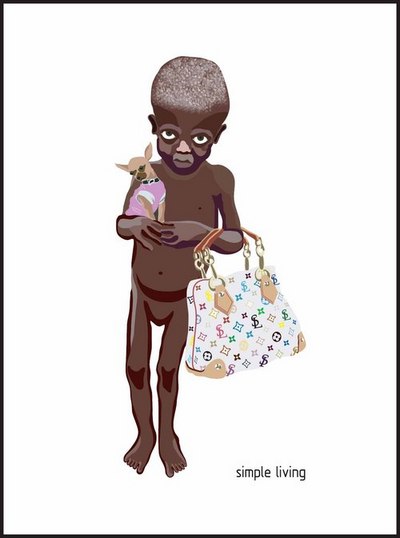
Nadia Plesner sued for this image.jpeg

In a T-shirt sold in 2008 to raise money for victims of violence in Darfur, artist Nadia Plesner depicted an African child holding a Louis Vuitton-style bag. So Louis Vuitton sued her. When she recently included the same design in a painting, it sued her again.

The first time around, Louis Vuitton claimed it wanted merely to stop her from selling the merchandise. This time, however, there is little pretense that it is about anything other than wanting the image gotten rid of. Paul Schmelzer writes:

Despite a clearly artistic -- and not commercial -- intention behind the work, Louis Vuitton is seeking monetary penalties (220,000 Euros or roughly $307,000 and counting, with no ceiling on the penalty) and aims to prevent Plesner from exhibiting the painting either on her website or at venues in the European Union. (Here's an unofficial English translation of the court order.)

LV sues artist Nadia Plesner [Eyeteeth]

Thursday, 24 March 2011

Trademark thought experiment: when should intermediaries be cops? (Barista vs. Barbie)


A little trademark thought-experiment: under a proposed UN treaty, Internet Service Providers (as well as search engines, social media sites, online auctions, online games, and sites like Etsy and Thingiverse) will be responsible for detecting and interdicting trademark infringement and helping punish infringers by retaining and providing their personal information on demand from a trademark holder, without a court order.

Now, many coffee shops today are ISPs (that is, one of the kinds of intermediary targetted by this proposal). And many coffee shops today are the locus of trademark infringement -- say, when you walk in with your kid clutching a fake Barbie from a stalls market or a blanket in Santee Alley or on Broadway. If you applied this intermediary liability standard to the real world, every barista would have to be on the lookout for this kind of trademark infringement. If someone in the shop were to say, "Hey, I work for Mattel, and that Barbie's a fake!" it would be the barista's duty to leap over the counter and take away the fake Barbie.

But her responsibility wouldn't stop there: her employer would have to set up cameras and cash-register logs so that they could identify infringers later. So after you left with your kid (who is by now in tears, screaming for her lost Barbie) (or "Barbie") the barista would have to pull your name off your credit card receipt and hand it over to the random dude who says he works for Mattel, without seeing any ID (much less a court order). And she'd have to print out the photos and turn them over too.

Or she could refuse -- but if she's wrong and the Mattel guy is right, well, her boss will be on the hook for the trademark infringement, too. The barista had better be some trademark expert if she plans on refusing the request.

Many institutions are "intermediaries" for bad acts: kids ride the subway to parties where they drink before they're legally allowed to; is it the transit authority's job to police alcohol laws? Cruel pet owners hit their dogs with rolled up newspapers; adulterers meet in hotels; fraudsters use telephones, pens, photocopiers and envelopes. All these criminal acts are not subject to policing by intermediaries -- why should one industry's civil actions be the entire world's responsibility?

Discuss.

(Image: Abandoned Barbie, a Creative Commons Attribution (2.0) image from derekgavey's photostream)

Tuesday, 22 March 2011

Obama administration recommends making illegal streaming a felony

from The People's Republic of Moronia

Here’s one story you won’t see going viral on a geek blog near you: the Obama administration is going to make torrent streaming, also known as P2P (peer to peer) sharing of music, a felony. A felony. This means, according to the Administration’s White Paper, recommending an upgrade to the act of illegal streaming of music to one of “financial espionage,” carrying prison time of up to 20 years.

This would apply to sites and people using, promoting (carrying ad-links) and hosting services like, the Pirate Bay, Utorrent, Bittorrent and Limewire derivatives. But what about the sites that just side with P2P and its lifestyle, like, Pirate Party, Zeropaid, TechDirt, Boycott-RIAA and Recording Industry vs People? Are they in danger too?

The White Paper, which makes the recommendations to Congress, includes as part of its focus, websites that “provide access to infringing products,” and would give local authorities “wiretap rights” in order to gather evidence. In other words, sites promoting the P2P lifestyle—in any way, would be investigated the same way as street gangs and the Mafia.

via Obama Crackdown on Illegal Streaming Signals End To Piracy | Moses Supposes:.

Sunday, 20 March 2011

Teens 'too blasé' about online legal dangers

by Peter Munro, The Age, March 20, 2011

VICTORIAN teenagers are ignorant of the legal pitfalls of using social media - such as posting explicit photographs of themselves or others online - and only 1 per cent would ask an adult for advice about dangers online, a study has found.

A Monash University-led study of more than 1000 year 7 to 10 students at 17 Victorian schools found social media was almost universal: 95 per cent of students used at least one social networking site and six in 10 updated their profile at least once a day. And 72 per cent had received unpleasant or unwanted contact from strangers via their online profiles.

But the study, Teenagers, Legal Risks and Social Networking Sites, found students were often blase about online dangers, with almost 30 per cent believing sites such as Facebook were risk-free. Parents and teachers also had little awareness of the ''potentially serious consequences'' young people faced, such as stalking, identity theft and harassment. Of concern was the prevalence of teenagers posting explicit photos of themselves or others online, the study found, citing the case of the 17-year-old girl who released nude photos of two St Kilda footballers on Facebook. Doing so could breach laws of privacy, confidentiality, defamation and copyright.

Children sending and receiving sexually explicit images on mobile phones - ''sexting'' - are also potentially liable under child pornography laws. The focus on cyber bullying had overshadowed the need to educate young people against breaking laws about privacy, copyright, defamation and distribution of offensive material, the study found. Students were ''really not aware of what the legal risks are'', said co-author Melissa de Zwart, associate professor of law at the University of Adelaide. ''Kids are taught at primary school that you don't walk into the toilet when someone is in there. Now nobody actually teaches them at any point in the classroom that posting really unpleasant photos of a friend is not appropriate; those social norms have to be learnt as well.''

Although nearly half the students were aware of some risk in using social networking sites, 28 per cent considered such sites safe and one in five felt any risk was irrelevant because social networking was ''what everyone does''. Although sites offered social and educational benefits, young people failed to understand the ''significant legal implications'' of their actions online. Many admitted posting third-party content: 26 per cent said they shared music online and 38 per cent shared videos, potentially breaking copyright laws. Less than 14 per cent were concerned about security risks such as identity theft.

Michael Henderson, a senior lecturer in education at Monash University, said students also needed to learn about the risks to reputations created by posting personal material online. The study, which will be released tomorrow, calls for ''cyber-safety'' lessons to be incorporated in school curriculums. ''Every school would have some sort of approach to social networking use, but what we are seeing is there is no concerted, clear effort across schools in this regard - partly because they don't know how to approach these issues,'' Dr Henderson said. Victorian Privacy Commissioner Helen Versey supported the call for cyber-safety education, saying young people were ''putting themselves at risk of running foul of the law''.

Former schoolteacher Mike Phillips, a co-author of the Monash study, said it was difficult to keep pace with digital technologies. His son Riley, 14, uses social networking sites such as Skype and Steam, a multiplayer games site, about five times a week. ''Even though I trust my son, it's when information gets online and falls into the hands of friends of friends that you tend to lose control - and that's a real concern,'' he said. Riley, a year 8 student, said he was careful online. ''With Skype video calls, I never show or do anything inappropriate because they could be recording and I'm very careful with my passwords because there's people out there who can hack into your account.''

Last week police charged a 17-year-old schoolboy with harassment in Sydney for allegedly hijacking a girl's Facebook page and posting an open invitation to her 16th birthday party, which drew more than 200,000 replies. The Victorian Council of School Organisations, which represents more than 500 school councils, said there was a need for a state-wide program on safe, respectful use of online networks.

[via]