Saturday, 8 April 2017

Cool animated overview of how media manufactures consent

Manufacturing Consent feels like a must-read all over again lately, and this excellent primer by animator Pierangelo Pirak lays out the five filters of the mass media machine.


Per Manufacturing Consent, this sounds as if it could have been written about those covering a certain sitting President:
A propaganda model has a certain initial plausibility on guided free-market assumptions that are not particularly controversial. In essence, the private media are major corporations selling a product (readers and audiences) to other businesses (advertisers). The national media typically target and serve elite opinion, groups that, on the one hand, provide an optimal “profile” for advertising purposes, and, on the other, play a role in decision-making in the private and public spheres. The national media would be failing to meet their elite audience’s needs if they did not present a tolerably realistic portrayal of the world. But their “societal purpose” also requires that the media’s interpretation of the world reflect the interests and concerns of the sellers, the buyers, and the governmental and private institutions dominated by these groups.
NOAM CHOMSKY - The 5 Filters of the Mass Media Machine (YouTube / Al Jazeera English)

via Boing Boing

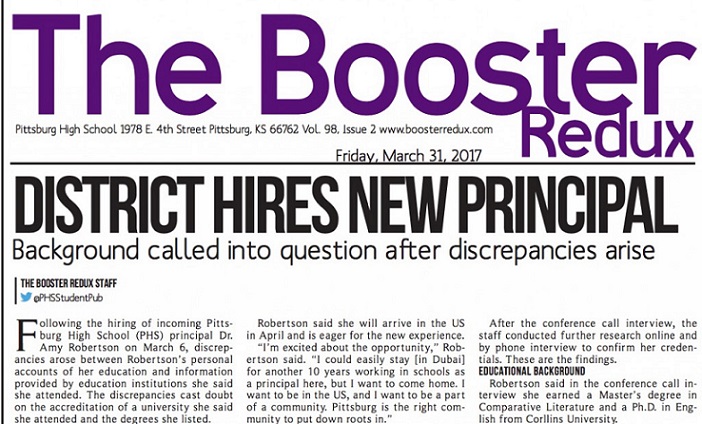
Kansas principal resigns after school reporters raise questions about her credentials


An incoming high school principal has resigned after the school's student reporters investigated and raised questions about her credentials. The Booster Redux, the student-run newspaper at Pittsburg High School in Kansas in the United States, started researching Amy Robertson after she was hired. Their research uncovered revelations about Corllins University, the institution Ms Robertson said she received her master's and doctoral degrees from. When the students tried to look up the university, the website did not work and they were not able to find evidence Corllins was an accredited institution."There were some things that just didn't add up," student Connor Balthazor told the Washington Post.


Ms Robertson, who currently works with an education consulting firm in Dubai, told the Kansas City Star she received her degrees in 1994 and 2010 with "no issue" before the university lost accreditation. She said all three of her degrees were "authenticated by the US Government". She declined to comment on questions posed by the students about her credentials because "their concerns are not based on facts". The Pittsburg School Board accepted Ms Robertson's resignation, saying she felt the decision was "in the best interest of the district ... in light of the issues that arose".

'They weren't out to get anyone to resign'

Superintendent Destry Brown praised the student reporters' work.
"I appreciate that our kids ask questions and don't just accept something because somebody told them," he said.
Mr Brown said questions were also being asked internally within his office, but that the students' public reporting "probably speeded that process". He said the district, which does not typically ask for official transcripts until after a hiring decision has been made, will likely change its vetting process. The school's journalism adviser, Emily Smith, said she was "very proud" of her students. "They were not out to get anyone to resign or to get anyone fired," she said. "They worked very hard to uncover the truth."

ABC/AP

Tuesday, 21 March 2017

The Kuleshov Effect

See original post at Futility Closet


In the 1910s, Russian filmmaker Lev Kuleshov demonstrated the power of film editing with a telling experiment: He intercut the “inexpressive” face of actor Ivan Mosjoukine with images of a plate of soup, a child in a coffin, and an attractive woman. Though the footage of Mosjoukine was the same in each case, an audience “raved about the acting,” noted director Vsevolod Pudovkin. “[They admired] the heavy pensiveness of his mood over the forgotten soup, were touched and moved by the deep sorrow with which he looked on the dead child, and noted the lust with which he observed the woman. But we knew that in all three cases the face was exactly the same.”
This reveals the effectiveness of montage, Kuleshov said. An audience reacts not to a film’s elements but to their juxtaposition — the sequence of images suggests an emotion to them, and they project this onto the actors. Alfred Hitchcock demonstrates:

How Does an Editor Think and Feel?

Film editor and theorist, Tony Chou has created a video essay on what choices a film editor makes.

For the past ten years, I’ve been editing professionally. Yet one question always stumps me: “How do you know when to cut?” And I can only answer that it’s very instinctual. On some level, I’m just thinking and feeling my way through the edit. So today, I’d like to describe that process: how does an editor think and feel?


Published on May 12, 2016


This Video Essay Explains the Invisible Magic of Movie Editing


Just as writers use punctuation to make their thoughts clear—commas to connect clauses, periods to signal the end of one thought and the beginning of another—filmmakers use cuts and transitions to make their films coherent, move between storylines, and advance plot. And whether you’re an aspiring filmmaker or a cinephile, understanding the basics of film editing can enhance your appreciation of a film. 
In “Cuts and Transitions 101,” RocketJump Film School gives an overview of the different techniques filmmakers regularly employ to move from shot to shot. In just eleven minutes, narrator Joey Scoma discusses cutaways, jump cuts, fades, dissolves, audio transitions, and more. “A lot of these cuts are so common and feel so natural that you don’t even think about it,” he explains. But while good editing might be so taken for granted we don’t even notice it, it’s the invisible sleight of hand that makes a movie feel magical.
By Anna Green via Mental Floss